

EU Inc: Malta’s Seat at the table
Opinion · An analysis of Malta’s role under EU Inc
For the first time, a founder in Lisbon, Tallinn or Valletta is about to be able to start one European company, a single company the whole Union recognises as its own. That is what EU Inc does, and it is the most consequential thing Europe has done for its startup founders in a generation. The fragmentation it addresses is the reason Europe’s best companies have, for years, quietly incorporated in Delaware and treated their home continent as a branch office. EU Inc is a standard for EU jurisdictions to serve, and Malta has excelled at similar challenges before, with ships.
What EU Inc is proposing
A company can incorporate in any member state while operating, hiring and paying tax anywhere else. The law follows the place of registration; everything else follows the place of business. The European Commission’s proposal (COM(2026) 321 the “28th Regime” corporate framework, published in March 2026) would introduce one harmonised company form available in every member state, with, in the text’s own words, founders “free to choose where to incorporate the company within the Union.”
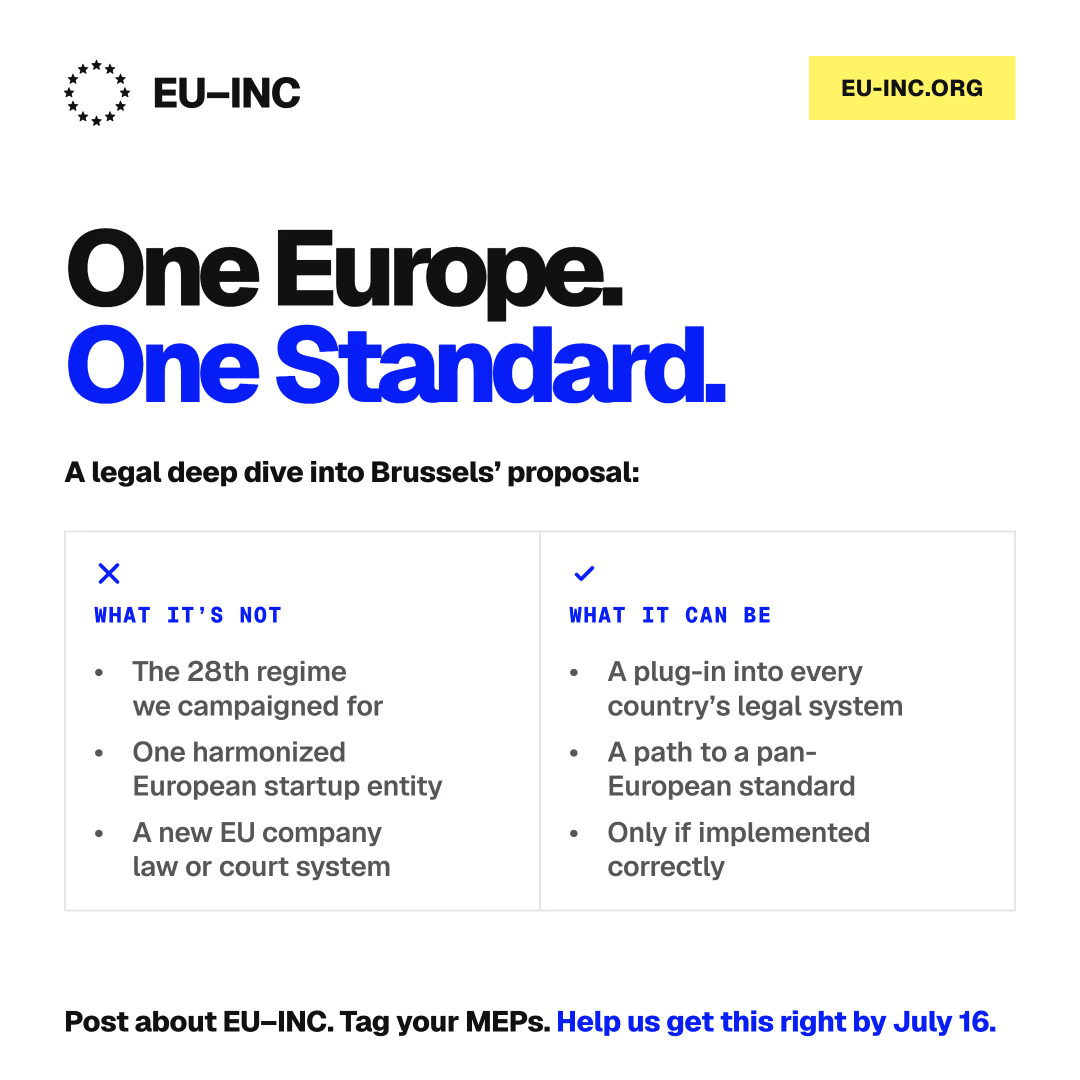
Crucially, the revised proposal is narrower than the original proposal. Tax and employment stay local: a French EU Inc pays French tax and applies French labour law. As Andreas Klinger, one of the campaign’s founders, puts it, “your French EU-Inc would fall under French taxes and employment law. Only corporate law would be standardised.” The company itself is digital by default, formed online in under 48 hours for no more than €100, without a notary, with modern share classes and built-in convertible instruments. The point is to end the fragmentation that, today, pushes Europe’s best start-ups to flip to Delaware anyway.
The seat clause is only the headline. Alongside it comes a whole company-in-a-box. Incorporation would be digital by default and genuinely fast, with standardised articles and, once registered, the company must be recognised and treated identically in every member state. The capital rules are stripped back to a token €1, with no paid-in minimum; founders can issue multiple share classes, including the multiple-voting and non-voting shares that growth investors expect, all dematerialised and transferable digitally without intermediaries. The text explicitly enables convertible instruments of the Silicon Valley “SAFE” variety (dubbed EU-Fast), and pairs them with a harmonised, regime for employee stock options, so that a start-up can hire and incentivise across borders from a single rulebook.
Around that core sit the practical fittings: a once-only data system that issues a tax and VAT number on registration and feeds the social-security and beneficial-ownership registers, anti-money-laundering checks built into formation, a requirement for at least one EU-resident director, and the ability to list on public growth markets without first having to convert into another corporate form. There is even a simplified, electronic route to wind a company down.
Two design choices frame the whole package: the form is optional and open to companies of any size, not just start-ups; and tax and employment law remain firmly national. It is, in short, an attempt to give Europe a single, modern, digital company and to do so without asking any member state to surrender its tax base.
What are the objections?
The objection arrives on cue: decouple the registered seat from where a company actually operates, and haven’t you just legalised forum shopping? a race to the bottom in which states compete by writing ever-laxer rules. A race to the bottom needs 27 different rulebooks to undercut each other. EU Inc replaces them with one. An EU Inc registered in Malta is, by law, the same instrument as one registered in Germany, same statute, same shareholder rights. What remains for a member state to compete on is not laxity but quality: the speed of its administration, the depth and clarity of its courts, the credibility of its institutions.
EU Inc harmonises the company; it leaves the scaling of that company largely national. As Anda Bologa argues in her clear-eyed critique for CEPA, the regime “cleans up the start and leaves much of the growth phase untouched” — Bologa, CEPA (2026): cross-border hiring, labour law, tax and insolvency all remain national.
These are not reasons to dismiss EU Inc. They are the job description for the jurisdictions that want to serve it. The regime hands a member state a harmonised company and says, in effect: the parts I left national are yours to make excellent.
The first is the court. Delaware’s real moat was never tax; it was the Court of Chancery — a specialised business court producing fast, written, predictable corporate-law decisions since 1792, layered with a century of precedent deep enough that most disputes already have a known answer. EU Inc creates no European corporate court; disputes go to the national courts of the registered seat. That is the single pillar the Regulation cannot supply centrally, and it is, conveniently, one a determined small state controls completely. The point is not partisan: René Repasi, the Social-Democrat co-author of the European Parliament’s report, makes exactly this ask “specialized court chambers and an alternative dispute resolution mechanism for ‘EU Inc.’ companies could help solve disputes quickly and create real trust” Repasi, via CEPA (2026).
The second is the digital rail, and here the model already exists. Estonia has spent a decade proving that a small state can make incorporation a software problem. Through e-Residency, launched in 2014, more than 135,000 people from 185 countries hold an Estonian digital identity; in 2025 alone e-residents founded 5,556 companies — roughly one in five of all new Estonian companies that year. A founder anywhere can incorporate online in an afternoon. Estonia is simply years ahead on the digital pillar, and even EU Inc’s advocates hold it up as the standard.
How Malta serves this moment
Malta’s advantage is that it has run a similar model before, for ships. The Malta Ship Register is the largest in Europe and the sixth largest on earth, with more than 8,000 vessels flying the Maltese cross. It did not get there by being the cheapest flag. It got there by being responsive, credible and relentlessly professional: a round-the-clock administration, a transparent tonnage-tax regime, and an EU flag that earned and kept its place on the Paris Memorandum “white list.” Malta became the flag of choice for the world’s most mobile asset by out-servingeveryone else, and it earned the reputation precisely by competing on quality and credibility. Malta’s maritime record becomes a blueprint for how to serve EU Inc.
The encouraging part is that Malta is already building the service layer. In May 2026 the government launched the Malta Business Wallet, a digital vault that lets a company hold and share its verified documents — IDs, bank statements, tax forms. Malta shipped this ahead of the EU’s own European Business Wallet, the Commission’s parallel proposal to give companies a single legally-effective digital identity, which Brussels hopes to agree only by the end of 2026 and which it estimates could save businesses billions in administrative cost. A small state moving first on the founder’s everyday friction is exactly the posture EU Inc rewards. And it is not only the government, Maltese startups are building the private half of the rail: Binderr, runs a marketplace that lets a founder submit one digital KYC profile and onboard with banks and corporate-service providers across jurisdictions, turning compliance, the thing that usually slows a cross-border company to a crawl, into infrastructure.
The moment
The Regulation is moving through the Council and the Parliament now, and the campaign’s window to shape the text closes in mid-July 2026. The EU Inc benefit accrues only to the places that decide to be useful first.
Becoming the jurisdiction of choice is not a matter of a logo or a marketing budget. It comes down to a handful of things a determined government actually controls. The first and most valuable is a robust legal framework: the country that stands up a specialised, English-language commercial legislation and courts producing fast, well-reasoned and published decisions on EU Inc matters will manufacture one of the key assets the Regulation cannot supply centrally. The second is administration: world-class digital incorporation that meets or beats the 48-hour standard. The third is the surrounding ecosystem of lawyers, accountants, corporate-service providers and banks that makes a jurisdiction the place where the expertise lives. The fourth is genuine substance and recurring services rather than from registration fees. And the last, is to wrap the whole offer in clear and transparent standards, so that the product reads as credibility, not risk.
Malta has done this before. The ship register grew into Europe’s largest on the strength of a fast administration, transparent standards, and institutions credible enough for serious owners to trust. Those same qualities reside in the EU Inc question, and each is within Malta’s control and will to execute. The task now is to bring that same discipline to companies.
Author bio: Adrian is a venture capital and portfolio management professional for early-stage startup investors.
For more information: www.clutchplayadvisors.co
Sources & references
- Andreas Klinger quotations — “You can just do things: Creating a pan-European legal entity, the right way,” klinger.io (2025).
- EU Inc proposal text & quoted clause — European Commission, COM(2026) 321, EU Inc corporate legal framework (March 2026).
- Anda Bologa, René Repasi and Reinier van Lanschot quotations — Anda Bologa, “EU Inc. Is Not Europe’s Delaware Moment,” CEPA / Bandwidth (2 April 2026).
- Delaware — Court of Chancery (est. 1792) and Fortune 500 share — Spotlight Delaware (2026).
- Estonia e-Residency — 135,000+ e-residents from 185 countries; 5,556 companies founded by e-residents in 2025 (~1 in 5 new Estonian companies) — e-resident.gov.ee (2026); Baltic VC (January 2026).
- Malta Ship Register — largest in Europe, 6th globally, 8,000+ vessels — Marine Insight (2024).
- Malta Business Wallet — launched 14 May 2026 by the Ministry for the Economy; 40+ businesses in the initial phase — gov.mt press release; The Malta Independent (May 2026).
- European Business Wallets — European Commission proposal; multi-billion-euro estimated admin savings; agreement targeted by end-2026 — digital-strategy.ec.europa.eu (2025–26).
- Binderr — Valletta-founded compliance & corporate-services marketplace; €2M seed (April 2024) — binderr.com (2024–26).


